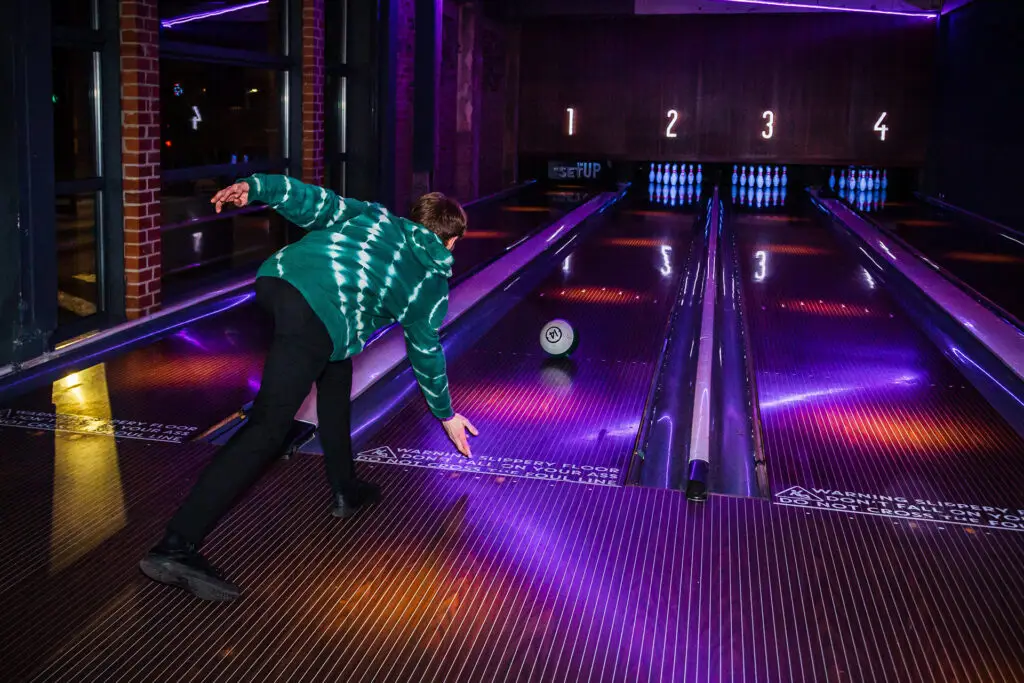
Bowling and kegeln (German ninepin bowling) are often mentioned in the same breath — and rightly so, since both games share a common basic idea: a ball, a lane, standing pins. But are bowling and kegeln the same thing? Far from it! So what actually is the difference between kegeln and bowling? Let’s take a closer look!
Definitions That Knock You Over: What Bowling and Kegeln Are Really About
What Is Bowling?
Bowling is an indoor sport that originated in the USA and is now played worldwide. The goal is simple: roll a heavy ball down the lane so that it knocks down the pins set up at the end. Anyone who hits all ten pins with the first throw scores a strike. Anyone who knocks down all the remaining pins with the second throw scores a spare. A game consists of ten frames, with up to three throws possible in the final frame.
Bowling is internationally standardized (the rules can be found here: https://bowling.sport/world-bowling-rules-and-regulations-as-of-september-2019/ ) and played by the same rules worldwide. The lane, the ball, and the pins all follow clearly defined dimensions set by international associations. This makes a fair comparison between players around the world possible.
What Is Kegeln?
Kegeln is a traditional European sport with a long history, found mainly in Germany, Austria, and Switzerland. It’s played on a kegeln lane, where nine pins (“Kegel”) are set up in a diamond formation. The goal here, too, is to hit as many of these pins as possible with a ball.
The term “Kegeln” actually covers several different variants: classic kegeln, sport kegeln, and “Scherenkegeln” differ in procedure and scoring. In many regions, kegeln has a strong social character and is often played in clubs or as a casual leisure activity.
When it comes to kegeln vs. bowling, one thing becomes clear: both sports look similar at first glance but follow their own rules and traditions.

Bowling and Kegeln: The Lanes
The differences between a kegeln lane and a bowling lane already start with length and material: a bowling lane is standardly around 18.2 meters long and 1.05 meters wide. It’s made of highly polished wood or a synthetic material and is regularly treated with oil, which specifically influences how the ball rolls.
A classic kegeln lane is usually somewhat shorter, typically between 19.5 and 25 meters, depending on the variant. Many kegeln lanes are found in club facilities, while bowling lanes today are often found in modern entertainment venues like Lane7.
Another difference: in bowling, there are so-called gutters on both sides of the lane that the ball can fall into. Classic kegeln doesn’t have these gutters in the same form.
Kegeln Ball vs. Bowling Ball: The Biggest Difference in Material and Weight
A central topic when it comes to the difference between kegeln and bowling is the ball: a bowling ball weighs between 2.7 and 7.3 kilograms and has three holes — one for the thumb, one for the middle finger, and one for the ring finger. These finger holes allow for controlled spin technique when throwing. Bowling balls are made of polyester, urethane, or reactive resin, which produces different rolling characteristics.
A kegeln ball, by contrast, is smaller and has no finger holes. Instead, it’s guided with the flat of the hand or the fingers. Its weight averages between 2.4 and 2.8 kilograms. Since the ball is played without a fixed grip, kegeln requires a different throwing technique.
The Pins: Nine or Ten?
Kegeln and bowling also differ in the number of pins. Bowling is played with ten pins set up in an equilateral triangle. In classic kegeln, nine pins stand in a diamond shape. This difference has a direct effect on strategy.
Scoring and Game Structure
In bowling, the scoring system is uniform worldwide: a game consists of ten frames of two throws each, with up to three throws possible in the last frame. Strikes and spares earn bonus points. The maximum score is 300 points.
In kegeln, the game structure varies depending on the variant. In sport kegeln, around 120 throws are played across several sections. Classic club kegeln, on the other hand, follows its own regional rules.
Here an overview:
|
Feature |
Bowling |
Kegeln (German Ninepin Bowling) |
|
Pins |
10 (triangle) |
9 (diamond) |
|
Lane length |
18.2 m (~60 ft) |
19.5–25 m (~64–82 ft) |
|
Ball weight |
2.7–7.3 kg (~6–16 lbs) |
2.4–2.8 kg (~5.3–6.2 lbs) |
|
Finger holes |
3 (thumb, middle, ring finger) |
None |
|
Max. score |
300 |
Varies by variant |
|
Prevalence |
Standardized internationally |
Regional (mainly DACH region) |
Bowling or Kegeln: What’s on at Lane7?
Kegeln or bowling — at Lane7 in Berlin, the choice is clear. On our modern lanes right at Potsdamer Platz, you’ll experience bowling in an atmosphere unlike anywhere else in Berlin. Moody lighting, beats, and stylish lanes — that’s fun on a whole different level.
But that’s not all: besides bowling, you’ll also find mini golf, darts, beer pong, karaoke, and a full bar with us. All under one roof, all bookable.
ENOUGH WITH THE READING. JUST COME PLAY.
Bowling for Groups: Large Bookings at Lane7
Anyone planning an event knows: the venue makes all the difference. At Lane7, no event is too big.
Whether it’s a corporate team night for 20 people, a birthday for 50, or an exclusive venue hire for 300 guests — Lane7 offers tailor-made packages that go far beyond an ordinary bowling night. Multiple lanes at once, exclusive areas, catering straight from our kitchen, and a full bar for your group. No compromises, no stress.
Your large booking at Lane7:
- Exclusive access to multiple bowling lanes at the same time
- A dedicated point of contact for all your planning
- Individually customizable packages with food and drinks
- A combination of darts, mini golf, karaoke, and other activities
- Flexible booking for corporate events, birthdays, stag/hen parties, and more
READY FOR SOMETHING BIGGER?